

Peer review isn’t free. So who pays?
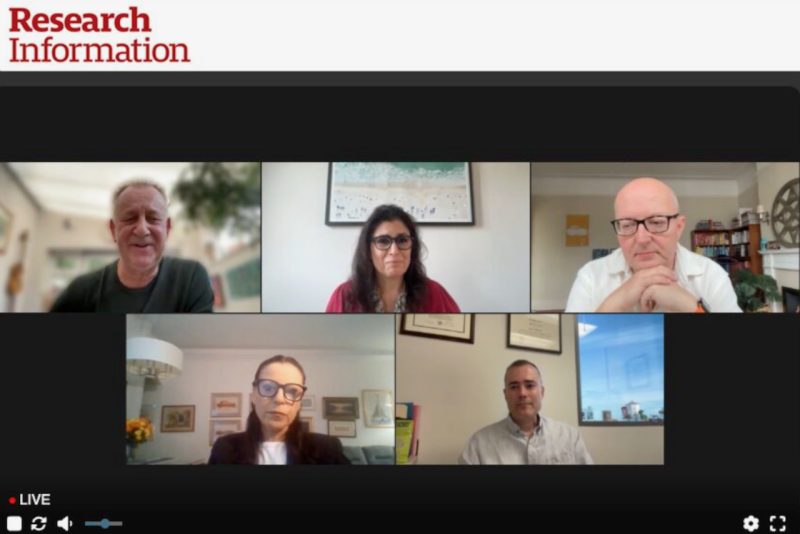
Research Information recently hosted a webinar on paid peer review. Tim Gillett gives a potted view of proceedings
Peer review may be fundamental to scholarly communication, but its economics have always been peculiar. Researchers routinely provide hours of highly skilled labour without payment, publishers expend considerable resources finding and chasing reviewers, and authors can wait weeks or months for decisions.
With submission volumes rising and academics facing increasing demands on their time, is that model still sustainable – and is paying reviewers part of the answer?
That was the question at the heart of a recent Research Information webinar, What is Peer Review Worth? Rethinking the economics of academic reviewing.
The panel brought together four perspectives: Gali Halevi of SCImago Research Group; Chris Leonard, Director of Product Solutions at Cactus Communications; Daniel Gorelick, Editor-in-Chief of Biology Open; and Maryam Bazargan, CEO of River Valley Technologies.
An opening audience poll illustrated just how unsettled the question remains. Asked whether peer reviewers should be paid, only around 7% said they should always receive payment. Some 35% thought they should be paid in some circumstances, 20% said no, while the largest group – 37% – was unsure.
WATCH THE WEBINAR, FREE AND ON-DEMAND, HERE
The hidden cost of ‘free’ peer review
Halevi challenged the idea that conventional peer review is really free. The system continues to function, she argued, and many researchers remain genuinely willing to contribute their expertise. But increasing submission volumes mean the pressure is growing.
“My concern is that we have come to depend on reviewers absorbing that pressure quietly. And we may not notice the cost until more of them begin to say no and begin to decline.”
Somebody, she pointed out, is always paying. For an employed academic, the institution may effectively meet the cost through the researcher’s salary, while reviewing consumes time that could otherwise be spent on research or teaching. For independent researchers and consultants, the cost can fall directly on the individual.
“At the end of the day, time is also a cost, right? So there are costs that are experienced differently, but they are real.”
Leonard believes the situation has changed markedly in only a few years. Five years ago, he said, he would have been confident there were sufficient qualified academics willing to review without payment. The explosion in submissions has changed that calculation: “It makes the idea of every submission being reviewed by two human reviewers unsustainable.”
One danger is that reviewing becomes concentrated among a relatively small group of “super reviewers”. Payment could help broaden and stabilise the available pool – although Leonard stressed that the incentive is not necessarily purely financial. Compensation can also send a signal that a reviewer’s expertise and time are valued.
Bazargan sees the problem partly through the infrastructure supporting peer review. Editors can spend considerable time identifying suitable reviewers, sending invitations and chasing responses. Better technology could reduce that friction, she argued, while respecting the limited time of both editors and reviewers.
What happens when reviewers are paid?
Biology Open, published by The Company of Biologists, has moved beyond theory with its Fast and Fair peer-review initiative.
The journal pre-contracts reviewers who have passed its screening process. When invited to review, they have one working day to accept or decline. Those accepting have four working days to complete the review. The handling editor assesses the result and, if it meets the journal’s quality requirements and deadline, the reviewer receives £220.
The results described by Gorelick are striking. Under conventional peer review, an editor at Biology Open had to approach an average of nine scientists to secure two reviewers. With Fast and Fair, that has fallen to around three. The proportion accepting an invitation and subsequently completing the review is about 98%, compared with roughly 60% under the conventional system.
Crucially, Gorelick said the journal has not seen a deterioration in quality: “We will never compromise rigour for speed, ever.”
Indeed, according to assessments by handling editors, review quality has increased slightly, although Gorelick cautioned against reading too much into that result. Improving quality was not the initial purpose of Fast and Fair; the important finding is that quality has not fallen. The model also creates an opportunity that can be missing from traditional peer review: feedback to the reviewer. When a review falls short, Gorelick can explain what was lacking and what would be expected if that reviewer is invited again.
Reviewers themselves have responded positively, he said, while authors benefit from receiving a decision quickly – even when that decision is rejection. Editors, meanwhile, can find reviewers in minutes or hours rather than spending days or weeks issuing invitations.
Peer review as a professional service
Cactus Communications has developed a different model, providing paid peer review as a service to publishers.
Leonard explained that Cactus already had a worldwide network of around 5,000 subject specialists through its manuscript-editing business. As generative AI began to change the editing landscape, the company considered whether those experts might also be trained as reviewers.
The answer turned out to be straightforward: many were already reviewing for journals.
Cactus consequently developed a service through which publishers can obtain a quality-controlled review within seven days. It can be used for problematic manuscripts where a journal has struggled to secure another reviewer, or more systematically as one element of the journal’s reviewing workflow.
That can significantly reduce the burden on internal editorial teams. Instead of repeatedly inviting volunteer reviewers in the hope of securing two acceptances, a publisher might source one itself and use a professional service for the second.
Leonard does not expect this to mean the end of voluntary reviewing. Prestigious titles may continue to attract academics prepared to review without payment. Elsewhere, however, he expects a more fragmented landscape: “Yes, I think an element of professionalisation will be a norm in a few years’ time.”
That professionalisation could also require more attention to training. Halevi noted that academics are rarely formally taught how to conduct peer review; they generally learn by doing it. Being an author does not automatically make someone a skilled reviewer.
For Halevi, the issue therefore encompasses workload, recognition and money. Peer review could be given greater weight in promotion and tenure, for example, while payment may be appropriate in other circumstances: “So it’s not all about the cash. It’s really also about recognition and finding the balance between teaching, researching, and reviewing.”
How much is a review worth?
If reviewers are to be paid, an obvious question follows: how much? For Biology Open, £220 was deliberately intended to be meaningful. Gorelick said smaller incentives were unlikely to change behaviour.
“One thing I was certain of is it needed to be an amount that was serious, you know. Fifteen or twenty pounds, or a nice bottle of wine, wasn’t going to cut it.” The figure was ultimately a compromise with the publisher, and Gorelick acknowledged that different researchers will value their time differently.
Cactus operates differently, charging publishers a service fee while reviewer compensation varies. Leonard said payments at the upper end are similar to those offered by Biology Open. Complexity may matter too. Cactus pays similarly for standard STEM and humanities and social science journal articles, but its book-review service costs considerably more because reviewing an entire book takes substantially longer.
Quality, integrity and unintended consequences
Payment also raises potential risks. Could reviewers accept too many assignments because of the financial incentive? Could fake identities and “review farms” emerge alongside the paper mills already troubling scholarly publishing?
For Gorelick, the answer is robust quality control. “If you turn in a low-quality review, or it’s not on time, you won’t get paid.”
Rather than assuming payment itself undermines quality, he argued that publishers should scrutinise how quality is controlled under existing unpaid models. Biology Open publishes the reviews associated with accepted Fast and Fair papers, allowing the research community to inspect the results.
Halevi also highlighted the cost of poor reviewing. A weak review that allows unreliable research into the literature can ultimately result in retractions, wasted publisher resources and damage to trust. The economics of reviewing therefore need to include the cost of getting it wrong, not simply the cost of commissioning the review.
Research integrity checks may increasingly be moved upstream rather than left to reviewers. Leonard said Cactus supplies an AI-generated research integrity report alongside its human peer reviews, while Bazargan argued that AI could be valuable for triage, methodology checking and preparation – allowing reviewers to concentrate their limited expert attention on the parts of a manuscript that genuinely require it.
Technology, however, is unlikely simply to replace human judgement. Bazargan envisages infrastructure doing more of the administrative heavy lifting, from matching available reviewers to manuscripts to tracking performance, enabling inline reviewing and potentially handling payments. “You need to have the accountability, the full audit trail, and essentially allow things to move faster.”
WATCH THE WEBINAR, FREE AND ON-DEMAND, HERE
Who should pay?
Perhaps the most contentious economic question is where the money ultimately comes from. If paid peer review becomes widespread, could publishers simply pass the additional cost to authors or already stretched library budgets?
Halevi was emphatic that this should not be the answer. “It has to be the responsibility of the journal, not the author, not the library, not the institutions that are already, right, caving under budget issues and rising costs.”
Bazargan went further, suggesting that paying reviewers need not increase overall publishing costs at all. If better systems and reliable reviewers substantially reduce the staff time currently spent identifying, inviting and chasing academics, the savings elsewhere in the workflow could offset the payment.
Leonard reported a similar experience. Removing a significant proportion of the editorial effort involved in finding and managing reviewers can make paid review at least cost-neutral for some publishers.
The debate also raised a more fundamental question: who is peer review actually for?
Halevi argued that its primary purpose remains service to research and the academic community, rather than service to publishers. “We do this for us, right, as a society, as a research community.”
A marketplace for peer review?
Looking five years ahead, three of the panellists saw some degree of professionalisation becoming increasingly normal.
Leonard expects paid review to become one component of a broader manuscript-evaluation system rather than something required by every journal for every paper. Halevi envisaged a marketplace in which trained professional reviewers could make their expertise available in much the same way as consultants. Bazargan similarly envisaged platforms allowing publishers to see reviewers’ expertise, availability, track record and perhaps their rates.
Gorelick offered a deliberately different scenario. His preferred future would see scientists refusing to provide free reviewing to highly profitable commercial publishers while continuing to volunteer their time for nonprofit and learned-society journals that return revenue to their communities. In that world, he suggested, payment might eventually become unnecessary.
He readily acknowledged the speculative nature of the idea: “This is maybe a dream more than a prediction.”
Whatever the eventual model, the webinar audience appeared noticeably less uncertain after hearing the arguments. By the closing poll, the proportion saying reviewers should be paid “in some circumstances” had risen from around 35% to approximately 63%. The proportion answering “no” remained around 20%, but the previously large “not sure” group had fallen from 37% to just 8%.
That shift does not settle the economics of peer review. If anything, the discussion suggested that payment is only one part of a much larger rethink encompassing technology, training, recognition, research integrity, editorial efficiency and the sheer quantity of material entering the scholarly publishing system.
But one assumption looks increasingly difficult to sustain: that expert peer review is free simply because the reviewer does not receive an invoice. Someone is already paying for it. The question facing scholarly communication is whether the way that cost is currently distributed remains fit for purpose.