

Charleston Premiers: 10 approaches to the changing research landscape
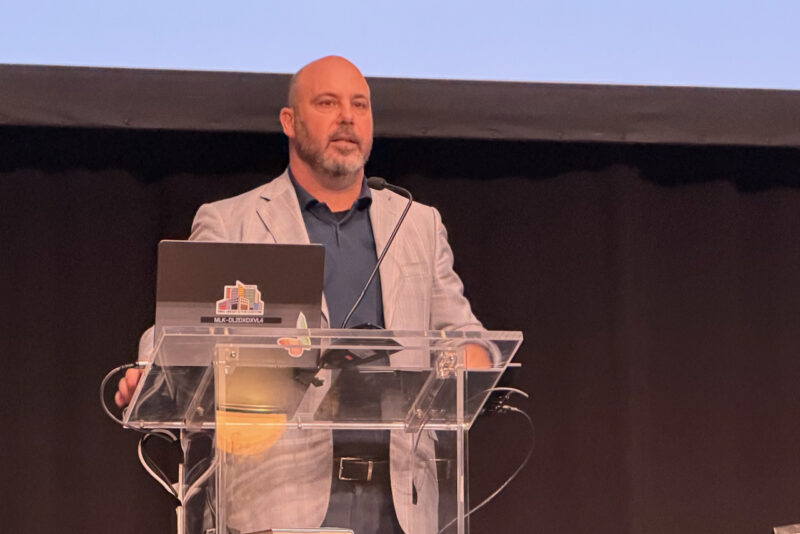
From bringing library collections into AI tools to rethinking peer review and subscription negotiations, Charleston Premiers offered a snapshot of innovation across scholarly communications.
Ten presentations, five minutes each, and an audience given the task of choosing the winners: Charleston Premiers brought a rapid succession of new products and ideas to the 2026 Charleston Conference.
Introducing the session, Michael Meth, Dean of the University Library at San José State University, emphasised the mix of first-time and experienced presenters, and a programme deliberately designed to extend beyond AI. Nevertheless, questions about how scholarship is discovered, trusted and valued in an increasingly AI-mediated environment ran through much of the session.
The format left no time for questions, with a separate meet-the-presenters gathering arranged for later in the day. Audience members scored each product’s design and potential impact, and cast a separate vote for the best overall product.
Ad Fontes Science: assessing reliability and relevance
Kent Anderson introduced Ad Fontes Science, a service intended to help libraries assess scientific information through direct examination of research, rather than relying on citation counts, usage or attention metrics.
Developed with Joy Moore and Ad Fontes Media founder Vanessa Otero, the approach adapts the thinking behind the company’s Media Bias Chart. Trained human analysts assess sampled articles against published criteria, with findings aggregated into journal, portfolio and publisher profiles.
Reliability assessments consider whether study designs suit the research question and whether conclusions are supported by the findings. Relevance examines factors including researchers’ expertise, originality and engagement with the scholarly community.
Anderson said coverage would begin with more than 300 journals in the first quarter of 2027. Static and interactive charts would support collection development, licensing, publishing advice and information literacy teaching. The team invited libraries to join a limited pilot programme, including an implementation charge and a subsequent 90-day free trial.
Meridian: connecting licensed scholarship with AI
Jonathan Woahn of Cashmere presented Meridian, an initiative bringing university presses and libraries together to connect scholarly collections with the AI tools researchers already use.
The presentation highlighted two weaknesses in current workflows: uncertainty about whether uploading licensed books to AI systems is permitted, and usage statistics that cannot distinguish a cursory download from hours of substantive engagement.
Meridian proposes a shared gateway using the Model Context Protocol, or MCP, through which compatible AI tools can retrieve authorised content, cite its sources and record usage. Cambridge University Press, Princeton University Press and Johns Hopkins University Press are founding participants.
Cashmere supplies the infrastructure for content ingestion, search, rights checks and reporting. The initiative is intended to become an independent, community-governed not-for-profit organisation.
For libraries, the proposition is to retain a visible role in discovery and access as research moves into conversational interfaces, while gaining better evidence of how licensed scholarship contributes to researchers’ work.
Rootwork: helping entrepreneurs interrogate business ideas
Vanderbilt University business librarian HD McKay presented Rootwork, an experimental application designed to help novice entrepreneurs investigate business ideas using credible data.
The starting point was a familiar library challenge: specialist business intelligence products can be expensive, difficult for inexperienced users and restricted in their commercial applications. General-purpose AI offers accessible answers, but can introduce fabricated claims and unreliable market estimates.
Rootwork uses coordinated AI agents to guide users through identifying customer segments, estimating markets and exploring competitors. It retrieves information from official government sources and publicly available business news, citing sources and explaining calculations.
Rather than removing every obstacle, its design deliberately introduces opportunities for fact-checking and reflection, encouraging users to question the evidence and remain in control.
Part of the wider Dataweb.ai initiative, the project is recruiting a distributed network of pilots through early 2027. McKay positioned it as both a practical service and a way for librarians to develop expertise through experimentation.
Citations: a paid route from AI answers to books
Jim Bryant presented Citations as infrastructure intended to connect AI discovery with publishers’ content and library services, while preserving rights and compensating participating organisations.
In the demonstrated workflow, a library connector allows an AI assistant to surface relevant books, display authorised passages, generate citations and direct readers to local holdings or digital borrowing services. With permission, users could then question a borrowed book or test their understanding of it.
The proposed financial model uses smart contracts, a distributed ledger and pre-funded AI company escrow accounts to allocate micropayments to publishers and libraries for authorised use. Bryant also described aggregated, privacy-protecting analytics to inform acquisitions, backlist development and foreign rights opportunities.
The presentation introduced the Charleston Circle, a free programme through which publishers and libraries can explore controlled MCP reading rooms and help shape proposed terms for AI companies. The central ambition was to make AI a route back to books and libraries.
Agreement Manager: modelling alternatives to the big deal
Tejs Nielsen Grevstad of ConsortiaManager demonstrated Unbundled, a new feature within Agreement Manager intended to help libraries evaluate alternatives to renewing large publisher agreements.
The presentation began with a hypothetical negotiating problem: an agreement costing $872,000, a proposed six per cent increase and a provost asking what alternatives existed. Answering requires understanding reading access, research output, citation patterns and publishing costs together.
Unbundled compares an existing agreement with a modelled combination of retained subscriptions, document delivery and interlibrary loan. It also considers article processing charges that could arise outside a publishing agreement, making assumptions about who would bear those costs explicit.
Subject librarians can refine the scenario to protect essential titles and assess disciplinary consequences, with financial projections extending five years ahead.
The message was that modelling should inform a decision, rather than promise savings. Libraries need a defensible account of an agreement’s value and the practical consequences of declining a renewal.
Liberata: sharing credit for quality control
Duke University PhD student Han Zhang presented Liberata, an academic publishing project built around changing the incentives for peer review, replication and research curation.
Its central proposal replaces conventional authorship positions with contribution shares: explicit proportions of the credit associated with a work. These are not financial assets. Authors can offer some of their shares in return for review or replication, recognising quality control as a contribution to the research itself.
Zhang argued that this gives reviewers a stake in a paper’s subsequent success, while producing more detailed information about contributions than author order alone can provide. Transactions could also reveal how communities value different services and expose patterns of inequality.
The ecosystem comprises Scriptura, a diamond open access publishing platform, and Mensura, a commercial metrics platform intended to support it financially. Zhang said both were available to test, inviting trials and partnerships around a model intended to align scholarly recognition with work that improves research.
Sage Policy Profiles: finding impact and future opportunities
Sage’s Camille Gamboa demonstrated how Sage Policy Profiles can help researchers discover where their work has influenced policy and identify opportunities to contribute further.
The free service uses Overton data to locate citations in policy documents, allowing researchers to track influence over time, export evidence and share personalised dashboards. Gamboa described researchers discovering substantial policy engagement they had previously been unaware of, with potential value for funding applications, promotion and institutional reporting.
A newer Policy Matcher feature extends the service beyond retrospective measurement. Researchers supply their publication history, a short biography and geographical interests, and receive relevant policy research opportunities, including links to the original listings and information about the organisations involved.
For librarians and research offices, the proposition is to support both demonstrating impact and developing it. Gamboa acknowledged that meaningful engagement still requires relationships and effort, but presented the tool as an accessible starting point for researchers unsure where to begin.
TrustMarc: making trust signals readable by machines
Toby Green introduced the TrustMarc Initiative through an Alice in Wonderland-inspired account of an AI creature that consumes publications but cannot recognise the trust signals surrounding them.
The underlying problem, he argued, is that peer review, editorial oversight and library curation communicate credibility to people without necessarily making that information accessible to machines.
TrustMarc proposes machine-readable certificates containing a trust narrative: information about an item’s provenance, stewardship and the processes through which it has been reviewed or selected. Its scope includes books, journal articles, grey literature and primary sources.
Libraries and publishers would issue certificates reflecting their existing work, within a framework overseen by an independent standards council. The aim is to make the basis for trust visible and portable across systems.
Green said development partners were being recruited, with a target of launching in March 2027 with at least 100,000 certificates before a wider rollout. The initiative seeks to carry established scholarly judgements into machine-mediated discovery.
LibKey: flagging problematic publishers during discovery
Third Iron co-founder and chief executive Kendall Bartsch presented an extension of LibKey’s research integrity features, designed to alert researchers when they encounter material from problematic publishers.
LibKey already combines article information with knowledge of available access routes, and has added retraction notices, expressions of concern and identification of articles citing retracted work. The new functionality addresses publishers whose deceptive or low-quality practices may compromise their output.
Bartsch said the assessment draws on publishing standards developed within the scholarly community, with AI-assisted analysis subject to human review. Warnings can appear in discovery systems, databases such as PubMed and through the company’s browser extension.
Researchers can inspect the reasons behind a flag, preserving a role for critical evaluation. Libraries also receive statistics showing how frequently users encounter flagged content in normal workflows.
The presentation positioned the service as a practical intervention at the point of discovery, bringing integrity information into the places where researchers already search.
Cat & Class: widening access to library infrastructure
Kay Ishola presented Cat & Class as a library services platform intended to make comprehensive infrastructure affordable to institutions beyond the largest research libraries.
The presentation argued that high platform costs have structural consequences for smaller libraries, affecting cataloguing, discovery and participation in shared services. Cat & Class brings acquisitions, cataloguing, circulation, discovery, analytics and institutional reporting together through independent modules.
A demonstration of ExpressCat showed how an ISBN or another identifier could retrieve records from authoritative databases, move them into a cataloguing workspace and publish completed metadata to the discovery interface.
Ishola emphasised that the platform was already in production, reporting sign-ups from more than 80 libraries across six countries. Support for third-party integrations and SIP2 was presented as a way to retain existing library hardware.
The company invited 15 founding libraries to participate across cataloguing and discovery or the full platform, offering subscription rates fixed for the lifetime of their subscription.
The audience’s verdict
Citations emerged as the session’s biggest winner, receiving the awards for most impactful product and best overall product. Meridian won the award for best design.