

Why scholarly publishing needs an independent certification authority

A universal certification framework is needed to distinguish trusted publishers from bad actors, writes Darrell Gunter
For centuries, scholarly publishing has served as one of society’s most trusted mechanisms for validating, preserving, and disseminating knowledge.
Researchers, universities, governments, corporations, and the public rely on scholarly publishers to ensure that scientific findings are rigorously reviewed, accurately presented, and permanently accessible.
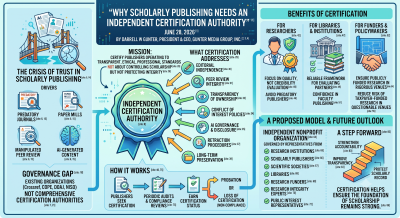
Yet today, the scholarly publishing ecosystem faces a growing crisis of trust. The rapid expansion of publishing outlets, the rise of predatory journals, paper mills, manipulated peer review processes, AI-generated content, and the increasing commercialisation of research dissemination have exposed significant weaknesses in the industry’s governance structure. While many publishers continue to operate with the highest standards of integrity, the absence of a universally recognised certification framework has made it increasingly difficult to distinguish trusted publishers from bad actors.
It is time for the scholarly publishing community to consider the creation of an independent certification authority dedicated to establishing and enforcing standards across the industry.
The governance gap
Unlike professions such as medicine, accounting, engineering, or financial services, scholarly publishing lacks a centralised mechanism for certification and accountability.
Today, a publisher can launch a journal, collect article processing charges, distribute content globally, and claim legitimacy with relatively little oversight. While organisations such as Crossref, COPE, DOAJ, NISO, and indexing services play important roles within the scholarly communications ecosystem, none were specifically designed to function as industry-wide certification authorities.
As a result, governance often becomes reactive rather than proactive.
Fraudulent publishers are frequently identified only after significant damage has been done. Retractions may occur years after publication. Indexing services may remove problematic journals only after repeated violations. Researchers, institutions, and funders are often left to navigate an increasingly complex landscape with limited guidance.
The current system places the burden of quality assessment on authors, librarians, reviewers, and readers rather than on a structured governance framework.
Why certification matters
Certification would not be about controlling scholarship. It would be about protecting its integrity.
An independent certification authority could establish clear criteria that define what constitutes a legitimate scholarly publisher. These standards could address:
- Editorial independence
- Peer review integrity
- Transparency of ownership
- Ethical publishing practices
- Conflict of interest policies
- AI governance and disclosure
- Data integrity standards
- Retraction and correction procedures
- Metadata and discoverability requirements
- Long-term preservation commitments
Publishers meeting these standards would earn certification status. Those failing to comply could be placed on probation, required to implement corrective actions, or ultimately lose certification.
This model mirrors the accountability systems that already exist in many other professions and industries.
Benefits for researchers
Researchers face increasing pressure to publish while simultaneously navigating a growing number of journals and publishing platforms.
A recognised certification system would provide a trusted signal that a publisher adheres to accepted industry standards.
Instead of spending valuable time evaluating whether a journal is credible, researchers could focus on the quality and impact of their work.
Certification would also help early-career researchers avoid predatory publishers that exploit authors while offering little value to the scholarly record.
Benefits for libraries and institutions
Academic libraries and research institutions invest millions of dollars annually in subscriptions, open-access agreements, repositories, and research infrastructure.
Certification would provide a reliable framework for evaluating publishing partners.
Rather than relying on fragmented indicators of quality, libraries could incorporate certification status into collection development decisions, transformative agreements, and institutional publishing partnerships.
Universities would also gain greater confidence that their faculty are publishing with organisations committed to recognised best practices.
Benefits for funders and policymakers
Research funders increasingly demand transparency, reproducibility, and public accountability.
A certification authority would help ensure that publicly funded research is disseminated through organisations that meet rigorous operational and ethical standards. Funders could incorporate certification requirements into grant policies, reducing the risk that taxpayer-funded research ends up in questionable publishing venues.
Similarly, policymakers would benefit from greater confidence in the scholarly infrastructure that supports evidence-based decision-making.
Benefits for the public
Perhaps the greatest beneficiary would be the public itself.
The COVID-19 pandemic demonstrated how quickly scientific information can influence public opinion, policy decisions, healthcare practices, and economic outcomes. When unreliable research enters the scholarly ecosystem, the consequences can extend far beyond academia.
An independent certification framework would make it easier for journalists, policymakers, educators, and citizens to identify trusted sources of scientific information. At a time when misinformation is widespread, strengthening trust in scholarly publishing has become a public interest imperative.
A proposed model
A future certification authority could operate as an independent, nonprofit organisation governed by representatives from:
- Research institutions
- Scholarly publishers
- Scientific societies
- Libraries
- Research funders
- Research integrity experts
- Information infrastructure organisations
- Public interest representatives
Its mission would not be to regulate research content or restrict academic freedom. Instead, its role would be to certify that publishers operate according to transparent, ethical, and professionally recognised standards. Certification could include periodic audits, compliance reviews, continuing education requirements, and public reporting.
Most importantly, the organisation would serve as an independent steward of trust within the scholarly communications ecosystem.
Looking ahead
Scholarly publishing stands at a crossroads.
Artificial intelligence, open science initiatives, increasing publication volume, and evolving business models are transforming how knowledge is created, evaluated, and disseminated. These innovations offer tremendous opportunities, but they also introduce new risks.
The future of scholarly communication depends not only on technological innovation but also on institutional trust.
Certification alone will not solve every challenge facing the industry. However, establishing an independent certification authority would represent a significant step toward strengthening accountability, improving transparency, and protecting the integrity of the scholarly record.
The scholarly publishing community has long been responsible for safeguarding humanity’s accumulated knowledge. The time has come to apply the same rigor to governing the institutions that steward that knowledge.
Trust is the foundation of scholarship. Certification can help ensure that the foundation remains strong for generations to come.
Darrell W Gunter is President and CEO of Gunter Media Group