

Charleston 2026: From AI experiments to everyday library practice
Artificial intelligence is opening up possibilities for library training, reference services and administration, but turning experiments into dependable working tools requires more than access to a chatbot.
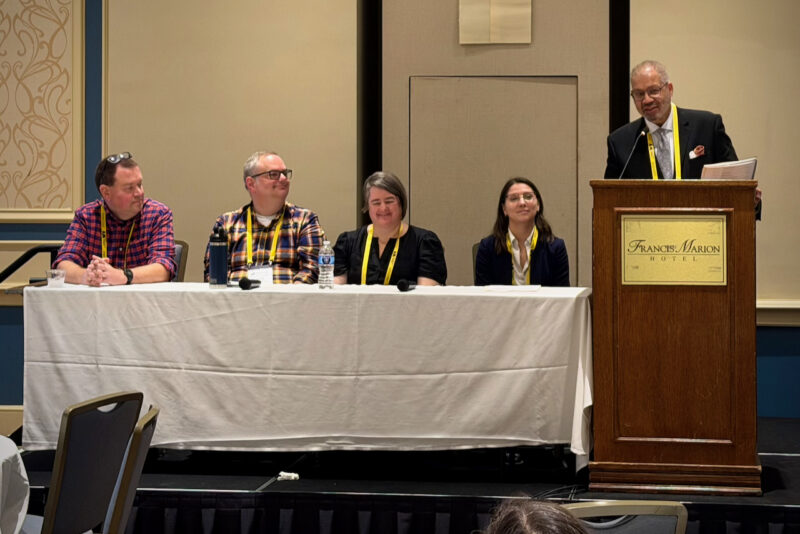
A Charleston Conference session – Building AI Capacity and Practical AI Applications – moderated by Darrell Gunter, global sales agent for institutional sales at Deutsche Grammophon, explored that challenge through four practical presentations. Speakers examined continuing professional development, repeatable document analysis, reference assistants grounded in institutional knowledge, and repository automation.
Across the session, a common message emerged: librarians’ expertise remains essential in defining the task, structuring the information and judging whether the technology delivers a useful result.
One AI workshop is not enough: building role-based AI literacy – Yulia Brusova, Library Associate, St Louis Community College
For many libraries, the first response to generative AI was a workshop introducing ChatGPT, discussing privacy and demonstrating possible uses. Those sessions provided an essential starting point, Yulia Brusova argued, but professional development now needs to reflect the different responsibilities of library workers and the growing body of knowledge available to them.
The problem is no longer simply a lack of training. Libraries have developed workshops, webinars and resources covering reference, instruction, cataloguing, collections and research. But this knowledge is scattered, making it difficult for staff to connect individual learning experiences or identify a coherent route through the material.
Brusova’s response was to create a free, openly accessible platform organised around three layers: shared foundations, role-based learning pathways and a living curriculum. The foundations establish a common understanding of generative AI, including its limitations, bias, hallucinations, privacy implications and ethical questions. Role-based pathways then connect these concepts to the professional situations staff actually encounter.
A reference librarian, for example, might need to verify citations and evaluate AI-generated information. Metadata specialists face different questions about data quality, while systems staff must consider integration and documentation. An access services worker helping a student at a busy evening desk needs enough understanding to respond appropriately, recognise boundaries and know when to refer the enquiry elsewhere. A single introductory workshop cannot adequately address all these situations.
The platform contains 18 modules across three levels. Foundational learning covers communication with AI systems, evaluation and ethical considerations. Practical applications address areas including reference, instruction, metadata, collection development and scholarly communication. Advanced material explores automation, coding, systems integration and leadership, alongside AI’s labour and environmental implications.
Brusova emphasised durable concepts and professional judgement over instructions tied to a particular interface. She also mapped the curriculum to professional competency frameworks, allowing learners to see which principles each module addresses. Downloadable PDFs, quizzes and a certificate provide other ways to engage with the material and demonstrate completion.
Although developed for colleagues at St Louis Community College, the platform had attracted an international audience. Brusova reported 524 visitors and more than 1,500 page views during the preceding month.
Her own development process illustrated the division of responsibility she advocated. She designed the curriculum, selected its content and tested the platform; AI helped implement the technical infrastructure. The presentation positioned AI literacy as an ongoing professional practice, with human expertise directing both what is taught and how the learning experience develops.
Getting repeatable results from generative AI – Amanda Yeslibas, E-resource Librarian, University of South Florida
Amanda Yeslibas approached generative AI from a technical services perspective: a tool is only useful if it can reliably produce the output needed for the job. Her presentation described lengthy, sometimes frustrating conversations with Microsoft Copilot while moving towards a structured approach based on explicit definitions, templates and a dedicated agent.
The initial task was reviewing vendors’ Voluntary Product Accessibility Templates, or VPATs. With hundreds of suppliers and documents potentially running to dozens of pages, manually extracting accessibility information represented a substantial workload. Yeslibas wanted consistent reports identifying areas of noncompliance and applying a defined scoring method to help compare vendors’ reported positions.
Early attempts produced serviceable results, but required considerable prompting. Long conversations became difficult to manage, and starting again meant rebuilding instructions. Her first approach used separate spreadsheet tabs for methodology, an automation prompt and a design template. After identifying one successful report as the model for subsequent outputs, she also found herself repeatedly supplying that example.
A separate project involving licence information and the Alma library management system suggested a better approach. Working with a data dictionary clarified the importance of defining each field: its name, meaning, permitted content and format.
Returning to the VPAT project, Yeslibas consolidated the requirements into a single spreadsheet template. It combined the scoring methodology, field definitions and an example layout. Instructions specified details such as whether a field should contain text or a date and how dates should appear. Testing revealed where further clarification was necessary.
The revised reports were more useful, including page references for identified accessibility problems. However, the model’s tendency to add unsolicited complexity remained an issue. A request to include notes prompted it to recreate a multi-tab structure; Yeslibas simplified the template again and explicitly placed the notes where she wanted them.
She then incorporated the template into a Copilot agent, creating a specialist environment that retained the reference material and instructions. Users could submit a VPAT and request a report without rebuilding the workflow each time. Moving from ordinary chat to an agent still changed parts of the output, requiring further testing and adjustment.
Yeslibas asserted that repeatability depends on making expectations explicit. Clear definitions, a stable reporting structure and repeated evaluation reduced the burden of prompting, while leaving the librarian responsible for checking the results. The agent simplified a recurring task, but did not eliminate the need to assess its behaviour.
Lasso your chatbot: tying institutional knowledge to LLMs – Joshua Borycz and Chuck Knight, Vanderbilt University
Joshua Borycz and Chuck Knight explored how library-owned information could make generative AI more useful for reference enquiries.
Their starting point was that librarians repeatedly answer similar questions, while some students and faculty never approach the library for help that could be readily provided.
Working through Vanderbilt’s Research Engagement Committee, they developed assistants designed to connect users with databases, relevant librarians and open access publishing opportunities. The projects drew on existing institutional information rather than expecting a general-purpose model to know the library’s resources and agreements.
Borycz’s database assistant used database descriptions and information about librarians’ subject expertise. Given a patron’s question, it expanded search terminology and recommended five relevant databases, alongside librarians who could provide further assistance. A separate open access assistant used information about publishing agreements and journal coverage to suggest suitable journals and indicate whether publication charges were fully covered or discounted.
The initial experiments used ChatGPT’s custom GPT functionality. The work subsequently expanded to dedicated websites bringing the tools and supporting information together. Development exposed familiar limitations – models sometimes treated firm instructions as optional, generated unreliable recommendations and even invented librarians. Borycz reported improvements as models evolved, while acknowledging the problems encountered during development.
Knight described a more specialised business resources assistant. Alongside the information already available in the library’s A-Z database listing, he wanted to capture practical knowledge about using individual products.
To support discovery, Knight added Library of Congress subject headings and organised information into linked Markdown files covering databases, subjects and categories. A knowledge graph represented the relationships between these entities, including broader and narrower subject terms. This gave the model a structured resource to query when assembling recommendations.
The assistant could use several tools, including keyword searches, category lookups, subject browsing and database descriptions. It gathered information before constructing an answer, following rules intended to ensure a consistent format, provide resource links and encourage contact with a librarian.
Future possibilities included incorporating LibGuides, frequently asked questions and more catalogue information. The speakers also envisaged making institutional knowledge accessible through users’ preferred chatbot environments.
The presentation demonstrated that a library’s contribution to AI-assisted discovery extends beyond providing access to technology. Curated descriptions, publishing agreement details, subject relationships and librarians’ practical experience supply the institutional context that makes an answer useful. Organising and maintaining that knowledge is therefore central to developing effective reference assistants, alongside continued attention to the accuracy of their recommendations.
Code, not clicks: rethinking repository administration at scale – Jeffrey Mortimore, Digital Scholarship Librarian, Georgia Southern University
Jeffrey Mortimore presented repository automation as both an opportunity to save staff time and a challenge of long-term software stewardship. AI-assisted development had enabled him to build tools for work previously dominated by repetitive clicking, but it also raised questions about maintenance, testing and technical debt.
Georgia Southern’s Digital Commons repository contains approximately 1,100 collections. Although the platform had supported more than a decade of collecting and discovery, administrative changes could require staff to visit and update large numbers of individual screens. Even a relatively simple adjustment affecting a few hundred collections could consume hours.
Mortimore’s response was the DC Admin Suite, a modular Python-based toolkit that interacts with an active administrative browser session. Using browser automation, it reproduces actions an authorised administrator would ordinarily perform manually. Its development rules include avoiding password storage and keeping actions attributable to the logged-in user.
The suite’s modules address distinct administrative needs. A URL tool gathers configuration and regeneration links, while a hierarchy mapper reconstructs parent–child relationships between collections. That hierarchy matters because some operations must follow a particular sequence: when regenerating collections after changes, child collections need to be processed before their parents.
A configuration manager exports collection settings and HTML into an Excel spreadsheet, where staff can make changes before uploading them again. Mortimore described work affecting around 250 collections being reduced to an automated job of approximately 45 minutes, during which he could attend to other tasks.
Other modules support HTML drafting, DOI-related XML generation and batch file downloads, including earlier versions of uploaded documents. The HTML tool allows staff to work within templates that accommodate the platform’s heading requirements, helping address accessibility concerns. Further work includes image text equivalents and PDF accessibility.
Mortimore distinguished between using AI to write software and using AI within a running workflow. Most modules described were conventional, command-based tools: AI had helped develop the code, but was not making decisions during their operation. Newer modules were beginning to call AI systems directly.
That distinction did not remove the maintenance challenge. Mortimore stressed the extensive testing involved and acknowledged his dependence on AI-assisted development. A platform change could disrupt tools that appeared reliable today, creating future work for the library.
The suite is available through GitHub, with a publicly shareable version alongside the internal production version. His closing argument was that sustainable library software requires a community. AI lowers barriers to building useful tools, but shared expertise, testing and ongoing support remain necessary if those tools are to survive beyond an individual developer’s immediate needs.