

The value stack: what will institutions actually be buying in 2030?

Steve Smith asks: after publication, who pays for the context, provenance, and judgment that make research usable?
For more than 20 years, there have been arguments about who should pay to read research and who should pay to publish it. Open access changed the terms of that argument without settling the funding question underneath it. In most cases it relocated the point of payment from readers and libraries to authors, funders, and institutions. That removed one barrier and raised another, particularly for researchers without reliable publication funding.
The AI era now surfaces a question the access debate never had to answer. After publication, who pays for the context, provenance, and judgment that make research usable?
Over the past year I have been circling a related set of ideas. That the industry is moving from selling access to content toward selling access to answers with knowledge as a service. That the unit of exchange is shifting from the PDF to the knowledge object. And (with Ben Kaube) that societies, in particular, may hold a distinctive community advantage in an AI-first world.
If those arguments are broadly right, the business model must evolve with them. The next step may be to build new floors on what came before: a value stack, where each layer is harder to reproduce, and harder to disintermediate, than the one below it.
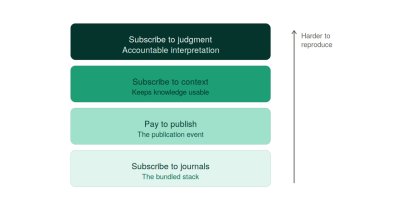
Subscribe to journals
The traditional subscription model needs little by way of introduction. Institutions pay for access to curated containers. A journal bundles several jobs into one product: registration, certification, dissemination, curation, and preservation. The subscription pays for reading, and the reading licence quietly cross-subsidises everything else.
The model has obvious problems, but it also has one underappreciated virtue: it funds the whole stack. Editorial judgment, metadata, archiving, platform maintenance and a certain amount of community governance were all funded at once, cross-subsidised by the reading license, even if nobody itemised them.
Pay to publish
Gold OA moved the money. Instead of charging for reading, it charges for publishing, a bounded transaction that completes at publication. The article processing charge pays for turning a manuscript into a reviewed, edited, openly available article.
That works when the product is the published article, and often it still is. Gold OA funds dissemination effectively. It gets the ship launched.
But a launched ship is not much use if no one keeps the charts current, the lights working, and the engine room running, so that humans and machines can still find the content, trust it, and use it properly three years later. The APC funds a publication event. But it is not usually designed to fund the continuing service layer around that event: the structured metadata, provenance, versioning, corrections, licensing clarity, and community-linked interpretation.
Subscribe to context
This is where AI complicates things.
AI systems are increasingly mediating how the scholarly record is discovered and used, and they interact with it differently from human readers. Todd Toler and Angela Cochran drew the distinction well earlier this year in their Scholarly Kitchen article. Content dissolved into model weights is a one-time sale of a depreciating asset. Content retrieved as context at inference time, cited, metered, and renewed, is an ongoing relationship. The phrase for the resulting business model is “subscribe-to-context”, and their warning is worth repeating: Publishers who do not control this layer may end up subscribing to someone else’s context, built on top of their own material.
Subscribe-to-context should mean something quite practical: paying for more than the right to read an article, and instead supporting the continuing work of keeping knowledge machine-usable and trustworthy. This means maintaining identifiers and links, exposing structured metadata, recording corrections and retractions, clearing rights for computational use, and serving all of it through reliable endpoints, APIs, retrieval layers, or MCP-style connectors that agents and institutional workflows can depend on. None of that is exhausted at publication.
An example to illustrate the difference: A CC BY article scraped into training data sits there as static memory. The model has no awareness that the paper was later corrected, or retracted, or that its data statement changed. A live, authenticated retrieval pipeline inside a library workflow calls back to a current source at inference time. It sees the correction, the retraction flag, the linked dataset, the licence. The institution is paying to ensure its researchers’ AI tools are not reasoning from stale, unverified material. That is a far easier product to imagine, and to price.
Read this way, context complements gold OA rather than competing with it. Gold OA funds dissemination. Subscribe-to-context funds structured, trustworthy reuse. A CC BY licence makes an article free to read and reuse. Keeping its links live and its provenance verified, and answering an agent’s query at three in the morning require additional infrastructure nobody has finished paying for. Someone still has to keep the engine room running.
There are signs the sector is already moving this way from several directions at once. The past few months have brought a burst of trust-marker activity: F1000’s VeriXiv trust badges, the TrustMarc initiative, and a new NISO Trust Markers working group among them. Different projects, one shared instinct. Journal brand alone increasingly feels insufficient, and trust now has to be made legible to machines as well as people. That is the same question the context layer raises. The question is openness, and also who maintains the trust layer, and how it travels.
Subscribe to judgment?
Context, though, may not be the top of the stack.
Structured context is valuable, but it is also, in principle, reproducible. A well-resourced aggregator can rebuild much of it from the outside: extracting figures, reconstructing links, inferring relationships, imperfectly and without attribution, but rebuilding it all the same.
The layer that is hard to reconstruct from the outside is judgment.
By judgment I mean the human work AI can imitate but not stand behind. An AI can summarise a field. It cannot take responsibility for the summary. It can rank papers. It cannot confer disciplinary trust. It can produce a plausible synthesis. It cannot underwrite it the way a named editor, evaluator, or expert working group can.
Judgment is also becoming more visible and more plural. Open peer-review reports, post-publication challenges, corrections, replication results, data checks, society recommendations, and formal evaluations can all accumulate around an article. Trust may come less from a single stamp applied at publication and more from a living record of who reviewed, challenged, corrected, validated, or endorsed the work, and when.
Stack Overflow is the cautionary tale. The content was always free, and any developer could copy a snippet. But the value of the platform was never the text. It was the reputation engine around it, the upvotes, the accepted answers, the visible standing of contributors, the curation that told you which answer would solve your problem without breaking your system. As AI assistants began serving the answers directly without the engine, participation fell sharply. The lesson is that open content and the judgment wrapped around it carried more weight than anyone had realized or priced.
The scholarly parallel is direct. An AI system may soon synthesise 500 preprints on a hot topic within seconds. What it cannot easily mimic is a society working group saying, with its name attached, this is the protocol our discipline currently stands behind. The product is accountable interpretation rather than more text.
Judgment is where accountability lives. Editorial standards applied by named people. Peer review recorded as a verifiable signal. Expert synthesis a community recognizes as authoritative. The contribution signals that show who convenes, reviews, mentors, and leads within a field. So perhaps the layer above subscribe-to-context is subscribe-to-judgment.
A public example worth watching is Sciety, which gathers expert evaluations and curation of preprints in one place. Sciety may be better understood as a signal of what a judgment layer might look like than as a settled business model: not more content, but organized evaluation, recommendation, and curation by identifiable communities. The open question is whether societies, publishers, or institutions will decide that this kind of ongoing expert interpretation is worth paying to sustain.
This also changes what journal brands must do. A journal can still signal that a threshold was crossed, but the brand alone is a blunt proxy. Its value may increasingly depend on how well it works with reviewers, societies, institutions, and expert communities to make the underlying judgments visible, attributable, current, and portable into AI workflows. The journal brand does not disappear. It becomes part of a wider reputation system.
Why societies are the interesting case
This is where societies become especially interesting.
As Ben Kaube and I argued in our recent Societies 2030 post, societies hold something commercial publishers and AI platforms cannot easily replicate: longitudinal signals about who reviews reliably, who convenes, who moved from early-career presenter to committee chair, who is trusted in practice rather than visible on paper. Those are more than engagement metrics. They are, at least potentially, the raw material of judgment.
A society funded entirely by APCs may be financing dissemination while leaving its most defensible asset undeveloped. The layers above the article are where its authority actually lives: seminar archives, structured community signals, curated synthesis, trust services, living dossiers, expert channels, and other ways of making judgment legible and useful.
In an AI-first world, a society may look less like one more source of articles inside someone else’s model and more like the reputation engine of its field.
One caution
As Alison Mudditt has warned, subscribe-to-judgment must not become a euphemism for rebuilding paywalls one layer up. The services built on context and judgment should be additive, things institutions choose to buy because they make research more usable and trustworthy, not tolls on access to the record itself. Getting that boundary right, in licenses, standards, and product design, is one of the harder problems of the next five years.
The question that remains
Gold OA helped answer the access question by making the article open. It did not answer how the context and judgment around that article should be maintained and funded.
So perhaps the real shift is from a single layer of value to several, rather than from one business model to another. Journals still matter. APCs may still matter. But context and judgment sit above them in the stack, and both may prove more economically important, and more defensible, than we have assumed.
The strategic question is no longer only how to license content to AI. It is which layer of value institutions will still pay you to maintain.
Which leaves one simple question for any publisher or society setting strategy now: When an institution subscribes to your content in 2030, what exactly will it be subscribing to?
Steven D Smith, DPhil, is the founder of STEM Knowledge Partners and an independent consultant.